For over twenty years, I have witnessed the transformation of the urban landscape in and around Seneca College, Newnham Campus. I first met this land as an Early Childhood Education student and eventually returned as an employee of Seneca Lab School Childcare.
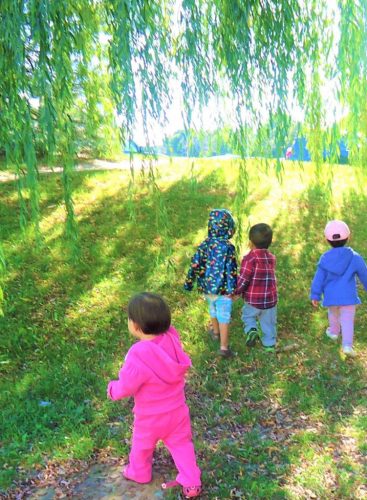
This land has always been valuable to myself and the children. Countless hours spent laying under the willows and pines, watching the branches gently sway in the wind; intertwining the cascading willow branches around our arms and dancing with beauty and grace. Feeling the skin of the trees brush sensually on the tips of our fingers and face; gathering collections of leaves, pine-cones, pine needles and fallen branches… magical gifts left for us.
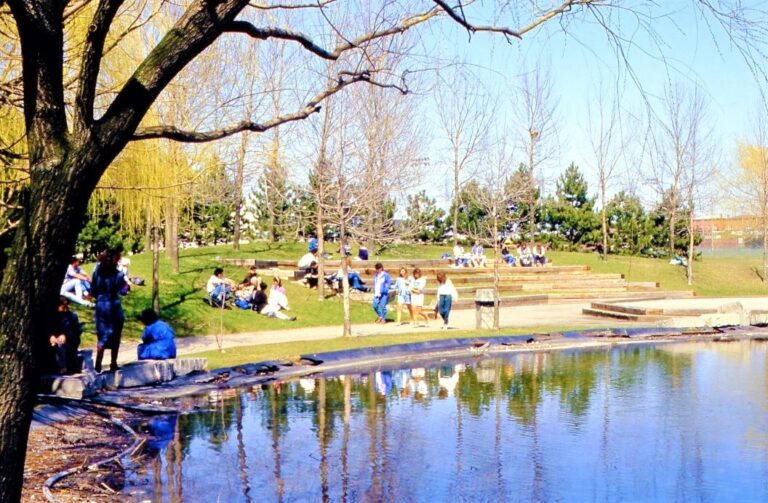
We had space to run free, climb up and slide down the majestic hills – mountains from a child’s perspective. Climbing the rock boulders and reaching down touching the water in the large, majestic pond adjacent to our building. Always honoring and appreciating what we had, with care. This was OUR community…these spaces have become our rituals and routines. Holding space and reverence for all beings; the birds, the geese whom welcome us year after year, finding safety in this land for new found birth. Marveling at the squirrels, chipmunks, raccoons, skunks, mice, and even rare sightings of fox and opossums. Gently greeting the emerging worms after the rain, welcoming and observing the ant colonies and the extraordinary miracles of the caterpillars transformation into butterflies each and every year. The bees buzzing and extracting pollen from the blooming flowers around our campus. The land has provided so many gifts throughout the years. We walk together, with virtue and gratitude; educators, children, families and students, plants and animals. An intimate community…
Department of Media Production, “Students Relaxing at the Newnham Campus Pond,” Seneca College 50th anniversary, https://frcrepository.senecacollege.ca/50/items/show/995.
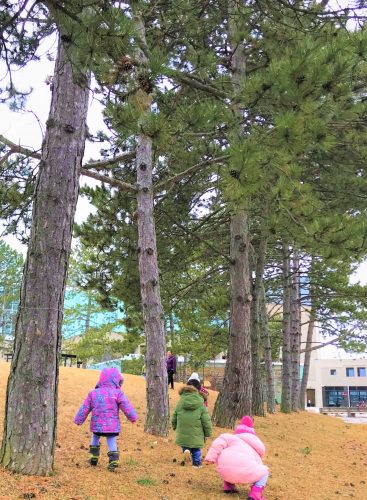
Louise Jupp, Early Childhood Education Professor, mentor and friend has always held value and worth for Seneca Lab School. Inspiring us with her progressive perspective and helping re-define pedagogical practices throughout the years. Louise has always revered the land, leading students, educators and children to find the magic and beauty within. Always coming back to the same spot; the land called her. She shared her vision of the small hill right outside our doorstep. A space lined by ten pines, standing side by side in a row, and the two majestic willow trees. The vision of a forest school was an ongoing continued conversation. A forest? Where is the forest? Why could I not envision this? I just could not see it, even with Louise sharing insights and possibilities. I considered a forest, as I had experienced them from my childhood. Losing myself in a vast land of trees within Conservation areas, Provincial and National parklands. I think about my countless journeys and hiking on this earth as a child, listening to the sounds underfoot from each step, the birds hiding high amongst the canopy and the silhouettes of the foliage in the glimpse of the suns rays through its vast density. I remember standing on top of a cliff looking at the colourful cascade of foliage below. I could not imagine this small hill with twelve trees as a forest, but would fully support my mentor’s vision.
As our population densified, so did our Post Secondary enrollment. I watched as piece by piece the land was destroyed, making way for new buildings. The pond becoming a parking lot, a vast space of open land made way for a residence building for students.
To this day I mourn the loss of these beings that provided us with so many moments, so many gifts.
The destruction of community…a vision destroyed. I mourned the death of the willows, pines and cherry blossom trees. The hill sloughed flat making way for ‘advancement’. I could not attend the funeral; I was at a loss for words. Unable to speak or write about the impact; for years, I buried my feelings. I felt as though a part of me was dying. How do I explain this to the children who were in relationship with this earth and now bare witness to human destruction? How do I watch the history and all the moments disappear? How do I sit back and watch the destruction of land that was here before us? How do I show my admiration and appreciation for all of the gifts we received? How am I implicated? How do I apologize and say sorry?
“When you like a flower, you just pluck it. But when you love a flower, you water it daily.”
– Buddah
With the ever-changing landscape I wondered how I could invite the land and its beings closer? How could I keep them close? To fertilize love and veneration within the children, educators, families, students and visitors? How can I show these beings their importance and existence in our lives?
We were inspired by noticing the children’s attraction to the windows in the classroom and the time they spent watching their community from indoors. Feeling the need to extend an invitation outside the gated pre-defined space of our playground; nature spoke to us. We collected cut logs and large tree stumps, creating a gathering sit spot for a small group at the side of our building, directly outside two large classroom windows. We added bird feeders and children created a daily ritual of feeding and visiting of the birds. I was astonished at the intimacy between children and birds, birds and children. The birds seemed to know and wait for the children, fluttering away to nearby bushes watching as the children brought them gifts. Squirrels and chipmunks amused us from the windows, and we enjoyed the yearly visits by the family of geese. We held this space as important and valuable as the indoor classroom, but I always wanted more. I always longed for the land at our sister school KOLTS, King Campus, having such a rich, vibrant landscape to adventure into. The pond, the forest, the meadow all on their doorstep, protected land.
I needed to breathe, step back, observe and reflect. Quietly…..listening with my ears, eyes and heart. Take the time to notice what the children were noticing. Listen to what they were listening to. I was astonished at their intensity. Two year olds, stopping and marvelling for an hour in one area. Investigating the details, hypothesizing and forming theories and just being in place. I was amazed at the community they led me to. The mapped landmarks which became familiarity and habit. Never rushing, but always finding something anew. Spending countless hours observing and marvelling with them. It was not until they discovered the row of bushes adjacent to our ‘birding’ area that my pedagogical view once again changed. Watching the children delicately manoeuvre themselves safely in, around, and out of the poking branches of a row of bushes; with such joy, care, freedom and such a sense of belonging. Only then did I begin to think of the definition of ‘forest’. Thinking from height viewpoint of a two year old, in six foot tall bushes lined twenty across, possibly provides a similar feeling of losing myself in the depths of the Provincial and National Parks I have visited in my lifetime. I think about the word ‘forest’. How is this defined?
According to Marriam Webster, a forest is “a dense growth of trees and underbrush covering a large tract.” The UN Food and Agricultural Organization (FAO), states “a forest must cover about 1.24 acres of land, and its canopy cover—the amount of land covered by the treetops—must exceed 10 percent of the acreage.” Cambridge Dictionary defines forest, “a large area of land covered with trees and plants, usually larger than a wood, or the trees and plants themselves,”
How am I to challenge these definitions? How do I re-define a word when it already has a set definition? I become vulnerable to others judgment as I challenge scientific reasoning and fact; by believing in and feeling the definition of a two year old. I will make the decision to once again set aside knowledge and information presented through research, and challenge my inner voice and the voices of the children. To respect the capabilities and spiritful lessons children express, and gift to me. The children have guided me to the forest…the forest is here!
During this global Covid 19 pandemic, I believe we are being provided the time to reflect and will forever be changed. A quote from Loris Malaguzzi, founder of the Reggio Emilia Approach especially resonates with me at this time.
“All of this is a great forest. Inside the forest is the child. The forest is beautiful, fascinating, green, and full of hopes; there are no paths. Although it isn’t easy, we have to make our own paths, as teachers and children and families, in the forest. Sometimes we find ourselves together within the forest, sometimes we may get lost from each other, sometimes we’ll greet each other from far away across the forest; but its living together in this forest that is important. And this living together is not easy.”
-Loris Malaguzzi (1994)
I hope we contemplate the things we have lost value for, and transform into a more beautiful, soulful spirit, connected to all beings.
I hope we ALL find place together.
I hope we will embrace the gifts this beautiful land provides us, and regard it with honor and care.
I hope we can hear the sound of stillness and welcome the lessons our earth teaches us.
I hope we can embrace the voices, spirit and languages of each child.
This work will not be easy…but one day, I hope we can ALL find the forest.
One thought on “In Search of the Forest… An Urban Perspective…”
What a thought-provoking and insightful experience you shared, Laura! Many of the points you made resonated with me in a deep and personal way. I am greatly awed by the way the image of the child has repeatedly arrested my attention whenever I observe them during any play/learning opportunity. The image of a child the forest story evoked in my mind is their free-spiritedness borne out of their innocence and purity of heart, which is reflected in their ability to see the wonders in their environment and in every material encounter. The image of a child is one of absolute trust without reservation – an important virtue that brings divinity close to mortality. This image is worthy of emulation and preservation.



What a thought-provoking and insightful experience you shared, Laura! Many of the points you made resonated with me in a deep and personal way. I am greatly awed by the way the image of the child has repeatedly arrested my attention whenever I observe them during any play/learning opportunity. The image of a child the forest story evoked in my mind is their free-spiritedness borne out of their innocence and purity of heart, which is reflected in their ability to see the wonders in their environment and in every material encounter. The image of a child is one of absolute trust without reservation – an important virtue that brings divinity close to mortality. This image is worthy of emulation and preservation.